
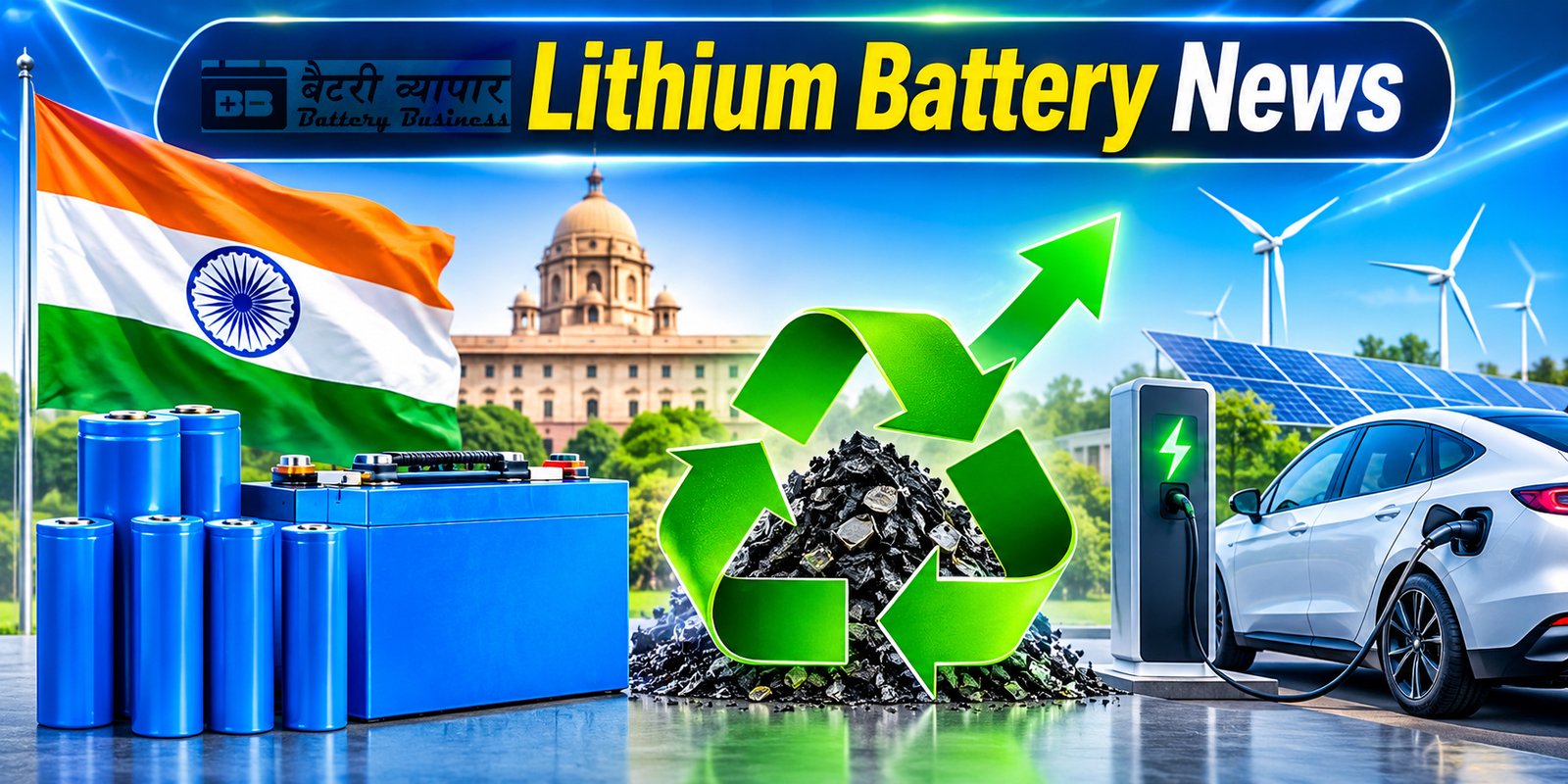
India’s lithium-ion battery industry is witnessing an important policy shift as the government focuses on strengthening domestic battery manufacturing, critical mineral recovery and recycling. Recent developments are expected to create new opportunities for battery manufacturers, recyclers, electric vehicle companies and energy storage businesses.
1. India Bans Lithium-Ion Battery Black Mass Exports
One of the biggest recent developments is the Indian government’s decision to prohibit the export of lithium-ion battery black mass. The Directorate General of Foreign Trade (DGFT) announced this restriction through Notification No. 49/2026-27 on November 10, 2026.
Black mass is a powder-like material obtained by shredding used lithium-ion batteries. It contains valuable minerals such as lithium, cobalt, nickel and manganese, which can be recovered and reused in battery manufacturing.
The government’s decision aims to ensure that battery waste generated in India is recycled and processed domestically instead of being exported to other countries. This move is expected to improve raw material availability for Indian recycling companies and encourage investment in the domestic recycling industry.
2. ₹2,814 Crore Incentive for Critical Mineral Processing
Another significant development is the Union Cabinet’s approval of a ₹2,814 crore incentive programme to strengthen India’s critical mineral processing capabilities.
The initiative focuses on developing domestic facilities for processing lithium and nickel ores and intermediate products into high-purity materials.
These minerals are essential for manufacturing electric vehicle batteries, battery energy storage systems and advanced electronic products. The programme aims to reduce India’s dependence on imported critical minerals and strengthen its position in the global battery supply chain.
3. New Opportunities for Battery Recycling Companies
The government’s export restrictions could create fresh opportunities for Indian battery recycling businesses. Domestic recyclers may receive better access to used lithium-ion battery materials, allowing them to improve production capacity and recover valuable minerals.
The development also supports the circular economy, where materials recovered from old batteries can be reused to manufacture new batteries.
4. Growing Demand for Lithium Battery Technology
Demand for lithium-ion batteries continues to grow across electric vehicles, electric two-wheelers, electric three-wheelers, solar energy storage systems, residential inverters and industrial applications.
Battery manufacturers are increasingly focusing on improving battery efficiency, safety, charging speed and overall lifespan.
5. Future Outlook
India’s lithium-ion battery sector is entering an important growth phase. Government incentives, domestic recycling policies and investments in battery materials could strengthen the country’s manufacturing ecosystem.
For battery manufacturers, distributors, dealers and recycling companies, these developments represent promising long-term business opportunities.
#LithiumBattery #LithiumIonBattery #BatteryNews #BatteryIndustry #EVBattery #BatteryRecycling #ElectricVehicles #BatteryTechnology #EnergyStorage #SolarEnergy #BatteryManufacturing #CriticalMinerals #MakeInIndia #CleanEnergy #GreenEnergy #EVIndustry #IndiaBatteryMarket #FutureTechnology #RenewableEnergy #BatteryBusiness