
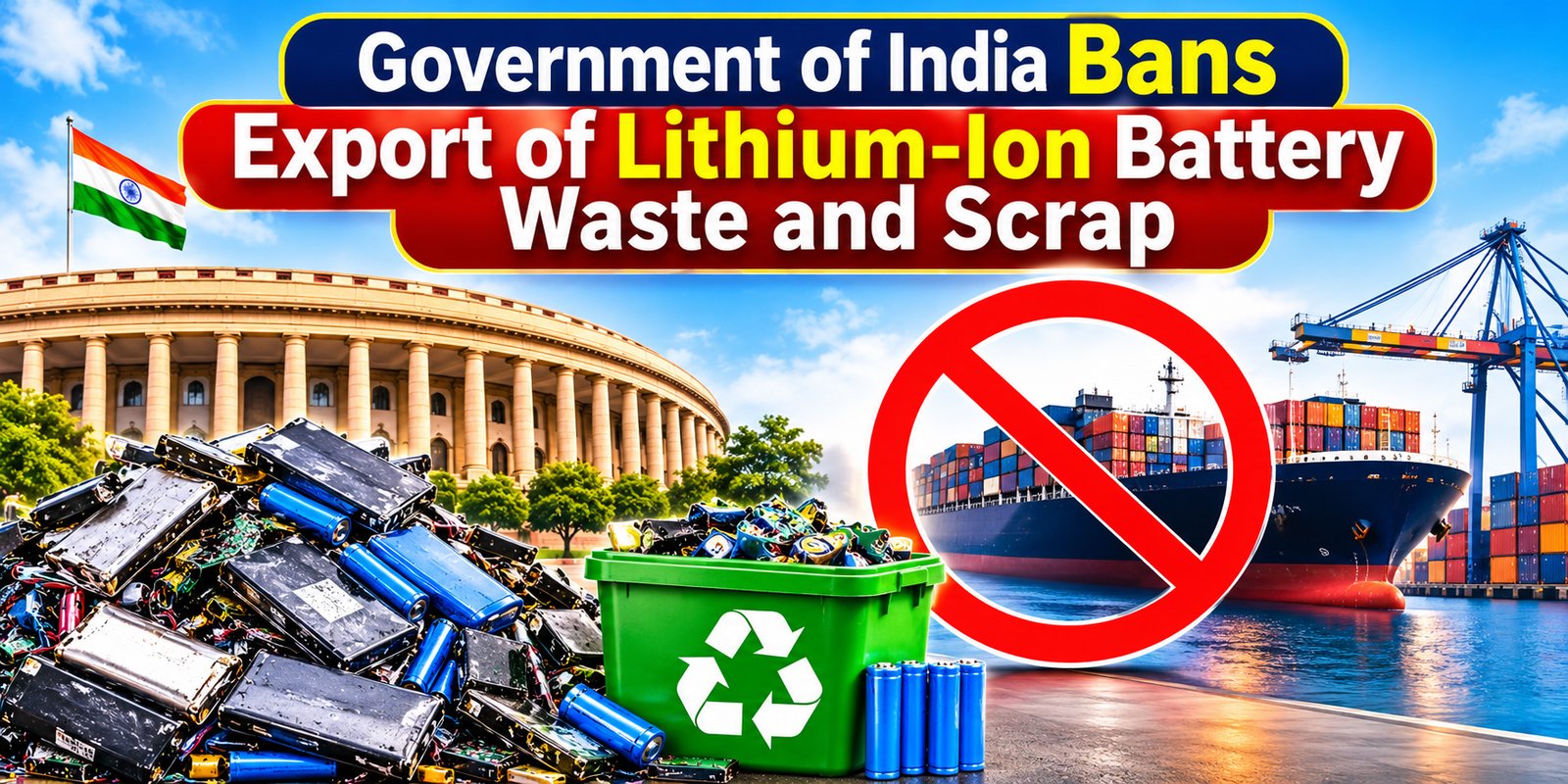
The Government of India has taken a significant step towards strengthening the country’s battery recycling industry by imposing an immediate ban on the export of lithium-ion battery black mass and specified categories of battery waste and scrap. The decision aims to retain valuable critical minerals within India, promote domestic recycling and reduce dependence on imported raw materials.
The Directorate General of Foreign Trade (DGFT), under the Ministry of Commerce and Industry, issued Notification No. 49/2026-27 on November 10, 2026. Through this notification, the government changed the export policy for lithium-ion battery black mass under ITC (HS) Code 85491400 from ‘Free’ to ‘Prohibited’, with immediate effect until further orders.
What Is Lithium-Ion Battery Black Mass?
Black mass is a powder-like material obtained by shredding and processing used lithium-ion batteries and battery manufacturing waste. It contains valuable minerals such as lithium, cobalt, nickel and manganese, which can be recovered and reused in the production of new batteries.
These minerals are essential for electric vehicles, energy storage systems, electronics, renewable energy technologies and advanced battery manufacturing.
Why Has the Government Imposed This Ban?
The primary objective is to ensure that valuable battery waste generated in India is processed and recycled within the country rather than exported to international markets.
According to the government, India’s battery recycling and mineral recovery capacities have increased, but many facilities are not being fully utilised because of insufficient availability of raw materials. In some cases, domestic recyclers have even needed to import black mass to fulfil their processing requirements.
The export restriction is expected to improve the availability of raw materials for Indian recycling companies, encourage investment, generate employment and increase the recovery of critical minerals.
Benefits for India’s Battery Industry
This decision could create new opportunities for domestic battery recycling companies and support India’s growing electric vehicle and lithium-ion battery manufacturing industries.
It will also help reduce dependence on imported lithium, cobalt and nickel, strengthen domestic supply chains and reduce foreign exchange expenditure.
The initiative complements the government’s ₹1,500 crore incentive scheme for promoting critical mineral recycling under the National Critical Mineral Mission.
A Major Step Towards Aatmanirbhar Bharat
The export ban represents an important development for India’s battery ecosystem. By retaining valuable battery waste and encouraging domestic mineral recovery, India can strengthen its circular economy, support sustainable manufacturing and build a more self-reliant battery industry.
However, the success of this initiative will depend on developing advanced recycling technologies, increasing processing capacity and ensuring environmentally responsible disposal and recovery of battery waste.
India’s move could prove significant for the future of electric mobility, renewable energy and domestic battery manufacturing.
#LithiumIonBattery #BatteryRecycling #BatteryNews #IndiaBatteryIndustry #LithiumBattery #BlackMass #ElectricVehicles #EVIndustry #CriticalMinerals #BatteryTechnology #BatteryManufacturing #BatteryWaste #DGFT #MakeInIndia #AatmanirbharBharat #RenewableEnergy #EnergyStorage #EVBattery #GreenEnergy #IndianEconomy