
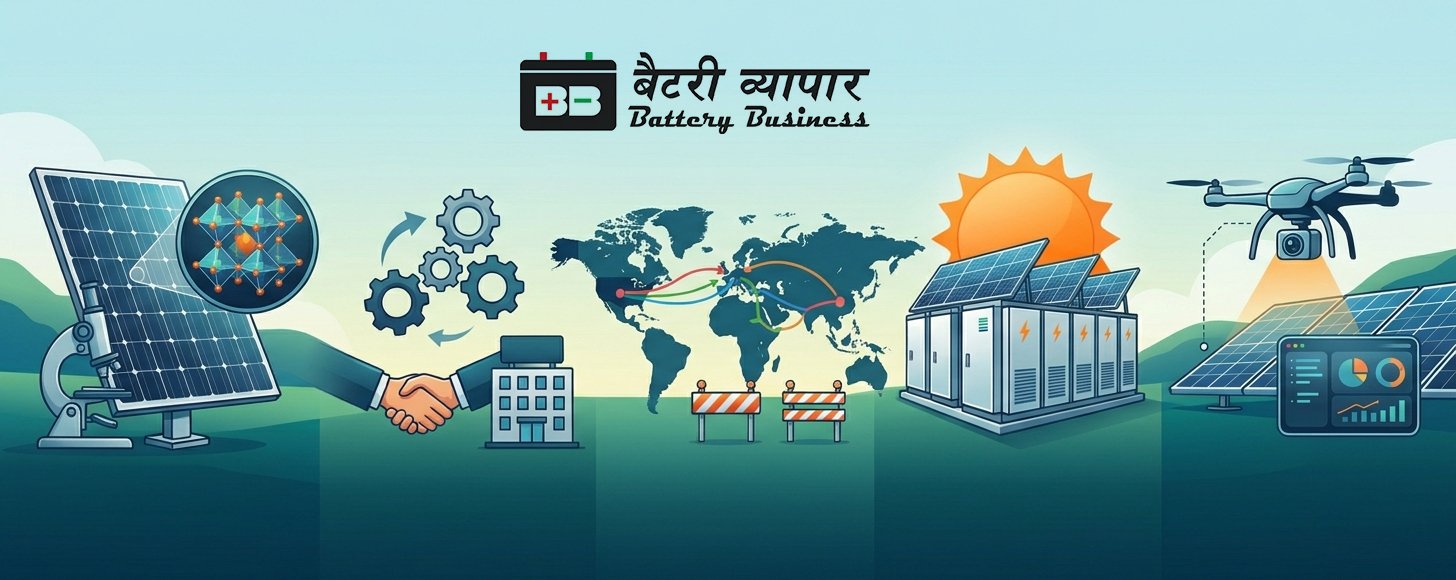
The solar business a massive shift from “growth at all costs” to “resilient, high-efficiency infrastructure.” As we cross the threshold of the mid-2020s, the industry is no longer just about panels on roofs; it’s about a complex ecosystem of high-tech manufacturing, AI-driven energy management, and intense geopolitical maneuvering.
1. The Perovskite Revolution Hits the Factory Floor
For years, Perovskite Tandem Cells were the “next big thing” in laboratory journals. As of early 2026, they have officially entered commercial production. Leading manufacturers like Oxford PV and several Tier-1 Chinese firms have moved beyond pilot lines to mass-market modules.
These tandem cells—which layer perovskite over traditional silicon—are shattering the theoretical limits of standard panels. While traditional monocrystalline panels hover around 20–22% efficiency, the 2026 commercial models are hitting 25–28%. For the solar business, this means a higher Return on Investment (ROI) for space-constrained projects, particularly in urban commercial real estate.
2. Strategic M&A: The Rise of the “Energy Giant”
The business of solar is currently undergoing a massive consolidation phase. In April 2026, we are seeing a trend of “backward integration.” Utility companies and tech giants (driven by AI data center power needs) are no longer just buying power; they are buying the companies that make the hardware.
-
Case in Point: Major acquisitions, such as Vikran Engineering’s recent move to secure a nearly 50% stake in NOPL Solar Projects, highlight a broader trend: engineering firms are morphing into independent power producers (IPPs).
-
The AI Nexus: The “AI Energy Nexus” is the primary driver of M&A activity this year. With data centers requiring massive, 24/7 clean energy loads, we are seeing consortium deals involving private equity firms like BlackRock and tech leaders to fund $100B+ “Gigawatt-scale” solar-plus-storage hubs.
3. Trade Wars and “Solar Protectionism”
The global supply chain is facing fresh friction. On April 28, 2026, the U.S. Commerce Department moved forward with preliminary antidumping duties on solar imports from several nations, including India.
This policy shift is intended to bolster domestic manufacturing, but it creates a complex “two-tier” pricing market. Solar developers in the U.S. and EU are now forced to choose between cheaper, tariff-heavy imports and more expensive, locally-sourced modules incentivized by subsidies. This has led to a boom in “transparency tech”—software that tracks the carbon footprint and origin of every solar cell to ensure regulatory compliance.
4. Storage is No Longer Optional
In 2026, the solar business is effectively the Solar-plus-Storage business. The global market for Battery Energy Storage Systems (BESS) is growing at an incredible 13% CAGR.
New financial “tolling agreements”—where developers provide the battery capacity and utilities pay for the right to use it—have become the standard business model. This allows for “Round-the-Clock” (RTC) renewable contracts, making solar as reliable as coal or gas for the first time in history. Floating solar (F-PV) is also seeing a resurgence, particularly in India and Southeast Asia, as land acquisition costs for ground-mounted plants skyrocket.
5. AI-Powered Operations and Maintenance (O&M)
The “business” of solar has moved into the cloud. AI-powered monitoring systems are now standard for utility-scale farms. These systems don’t just report outages; they use predictive analytics to schedule cleaning robots and identify “hot spots” before they lead to panel failure. This tech is boosting operational efficiency by an estimated 10–15%, significantly tightening the margins for O&M service providers and making solar assets more attractive to institutional investors.
Key Market Statistics (April 2026)
| Metric | 2026 Forecast | 2035 Target |
| Global PV Market Size | $345 Billion | $694.5 Billion |
| Avg. Tandem Efficiency | 26.5% | 32% |
| Storage Integration Rate | 65% of new builds | 90%+ |
The Bottom Line
The solar business in 2026 is a high-stakes game of technology and policy. Companies that fail to integrate storage and AI-driven management are being left behind, while those mastering the “Perovskite-Silicon” shift are commanding premium valuations. As the world pushes toward Net Zero, the solar industry has transitioned from a “green alternative” to the primary engine of the global economy.
#SolarBusiness #RenewableEnergy2026 #Perovskite #EnergyStorage #GreenTech #SolarPower #CleanEnergyNews #SustainableInvestment #AIEnergy