
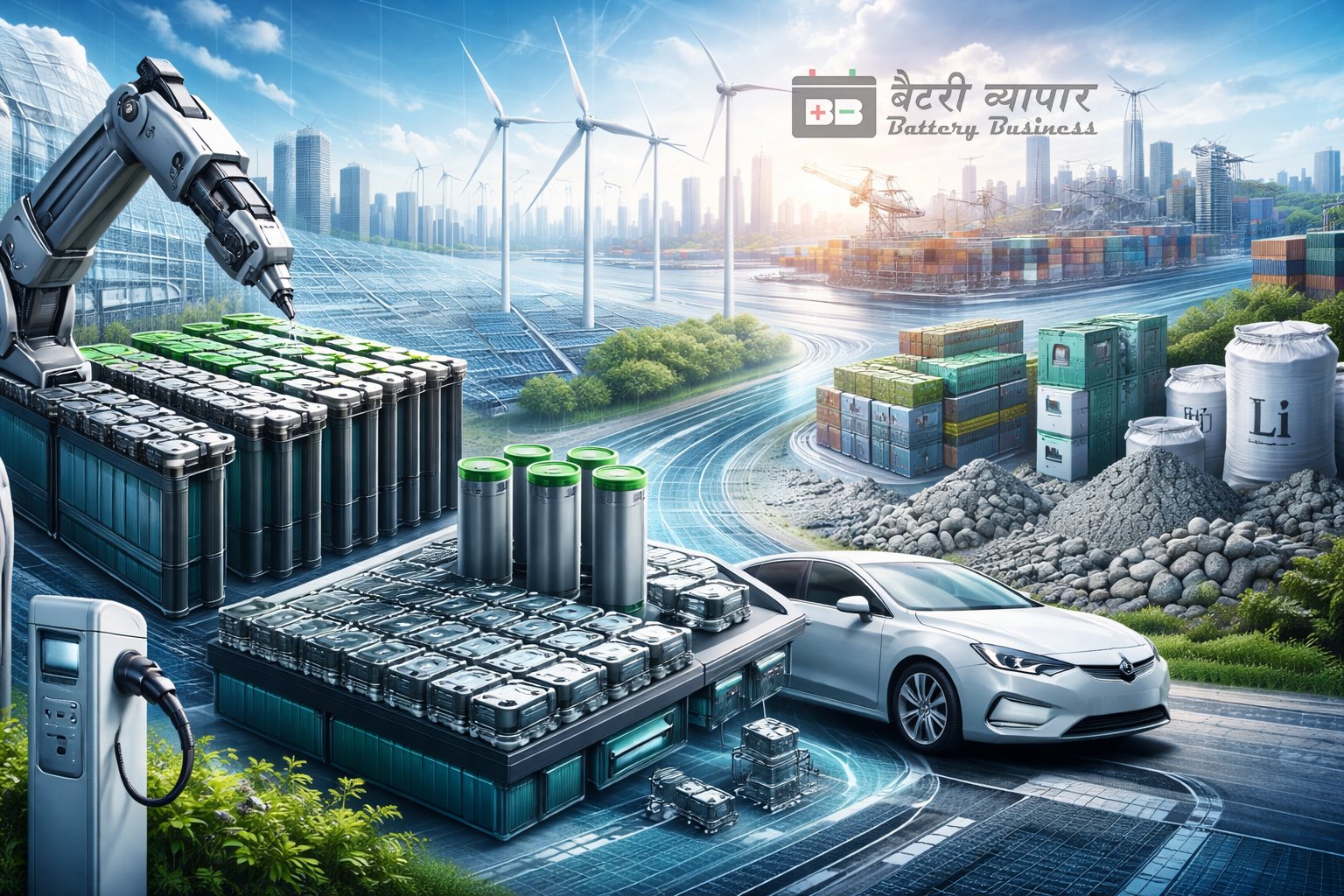
The global battery industry is moving at high speed today, driven by innovation, policy shifts, and manufacturing expansion. One of the biggest developments is the continued dominance of Chinese battery giants CATL and BYD, which together continue to hold a major share of global EV battery installations, reinforcing China’s strong grip on battery supply chains.
Solid-state batteries remain a major talking point worldwide. Several companies are pushing commercialization timelines forward, while industry experts remain cautious and are demanding stronger validation before calling it a true breakthrough. At the same time, sodium-ion batteries are gaining traction as a lower-cost alternative, especially for energy storage and entry-level EV applications.
In manufacturing news, global investment in battery gigafactories continues to expand. New production lines, electrolyte filling equipment demand, and localization strategies are shaping the next growth wave. The United States and Europe are accelerating domestic production to reduce dependence on imports, while Latin America is emerging as a new battleground. In Brazil, battery makers are seeking government support to prevent cheap imports from dominating the upcoming storage market.
Battery raw material economics are also improving. Falling battery pack prices, especially in LFP chemistry, are helping EV adoption and grid-scale storage economics. Analysts say lower costs could support faster renewable integration and stronger demand for residential and commercial energy storage systems.
Another major trend is recycling and circular battery supply chains. More companies are investing in second-life batteries, lithium recovery, and closed-loop manufacturing. This is becoming critical as sustainability regulations tighten and automakers seek secure long-term material supplies.
Meanwhile, the lead-acid and industrial battery sector is also seeing momentum, especially in telecom backup, inverter batteries, solar storage, and industrial motive power. Demand remains strong in developing markets due to unreliable grids and rising backup power needs. Battery manufacturers are increasingly integrating smart monitoring, fast charging, and improved durability into conventional technologies.
On the risk side, the industry continues to watch startup viability after major setbacks among some Western battery ventures. Investors are now favoring scalable technologies, stronger balance sheets, and proven execution over hype-driven growth.
For the solar-storage market, hybrid inverters paired with lithium batteries continue to gain attention as residential and commercial consumers prioritize energy independence, peak shaving, and DISCOM-compliant smart power solutions. This segment is expected to see rapid growth in 2026.
Overall, today’s battery industry story is defined by five themes: lower costs, bigger factories, new chemistries, supply-chain localization, and smarter energy storage. From EV batteries to inverter batteries, from recycling to solid-state innovation, the sector is evolving faster than ever and remains central to the global energy transition.
#BatteryIndustry #EVBatteries #LithiumBattery #SolidStateBattery #SodiumIon #EnergyStorage #BatteryNews #SolarBattery #HybridInverter #LeadAcidBattery #BatteryRecycling #Gigafactory #CATL #BYD #RenewableEnergy #CleanEnergy #PowerBackup #IndustrialBattery #BatteryTechnology #EnergyTransition